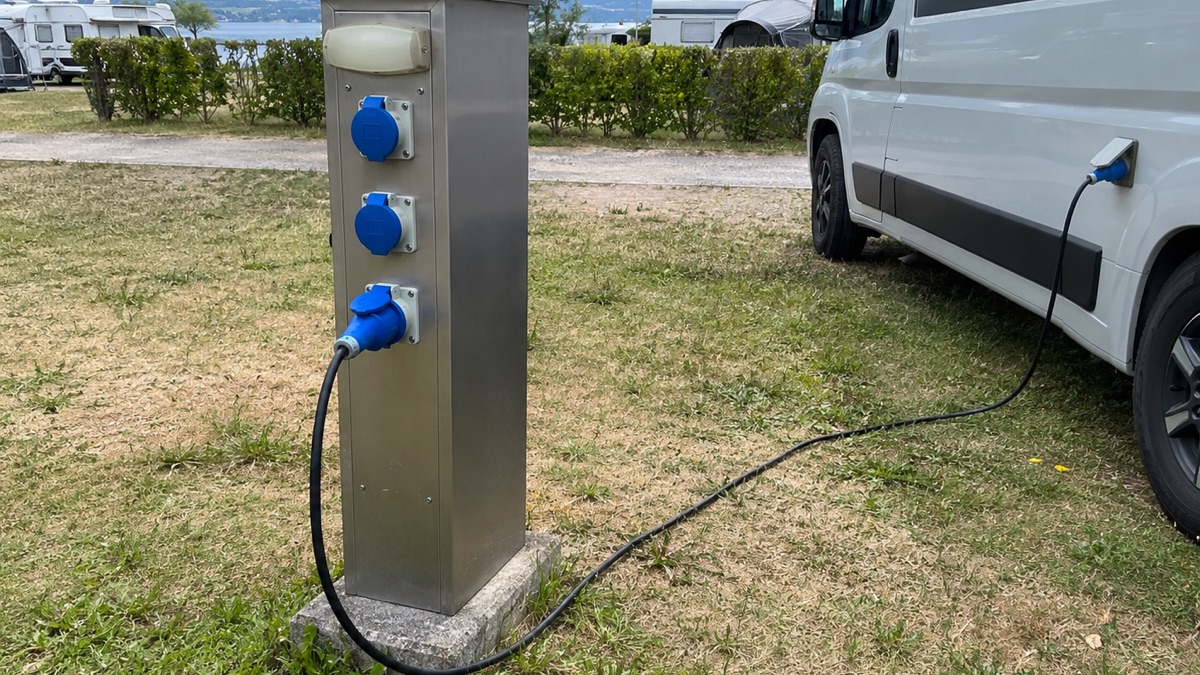
On most campsites in Europe, power comes from a post or bollard with blue CEE sockets. In the UK this is called electric hook-up, or EHU for short. A normal household plug won't fit. With the right cable, though, it's sorted in no time.
What you need
- An extension cable with a blue CEE plug and a blue CEE coupler for 230 volts and 16 amps, with three cores of 2.5 mm² each. A robust rubber cable such as H07RN-F 3G2.5 is the usual choice.
- 25 metres long is the usual length, and don't join a second cable onto it. Many sites don't allow joiners or splitters.
- An adapter from CEE to a household socket, in case your device only has a normal plug.
- Plug, coupler, adapter and cable reel rated at least IP44, meaning protected against splashing water.
How much can you run?
The post or the reception will tell you how many amps your hook-up has. Often it's 6 to 16, on many UK sites 10 or 16. Multiply by 230 to get the power in watts, so about 1,400 watts at 6 amps. A normal kettle, hair dryer or fan heater often needs 2,000 watts or more. If the fuse trips, often only reception can help.
How to connect
- Plug the cable into the vehicle or device first, then into the post.
- Unroll the cable completely, including from the reel. Coiled up, it can get hot.
- Lay it so nobody trips and no car drives over it.
- When packing up, do it the other way round: unplug at the post first, then at the vehicle.
Sources
- The Caravan and Motorhome Club: Hooking up to the mains
- The Camping and Caravanning Club: Electricity for campers and caravanners
- IEC 60364-7-708 (in the UK BS 7671 Section 708): Electrical installations in caravan and camping parks
- EN 60309 (IEC 60309): Plugs, socket-outlets and couplers for industrial purposes