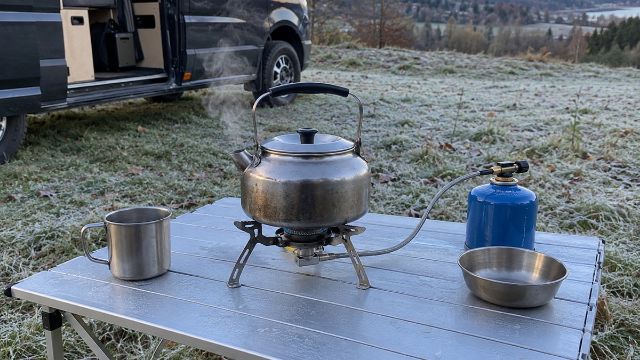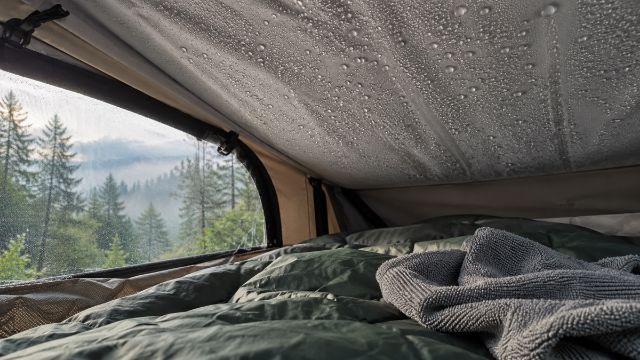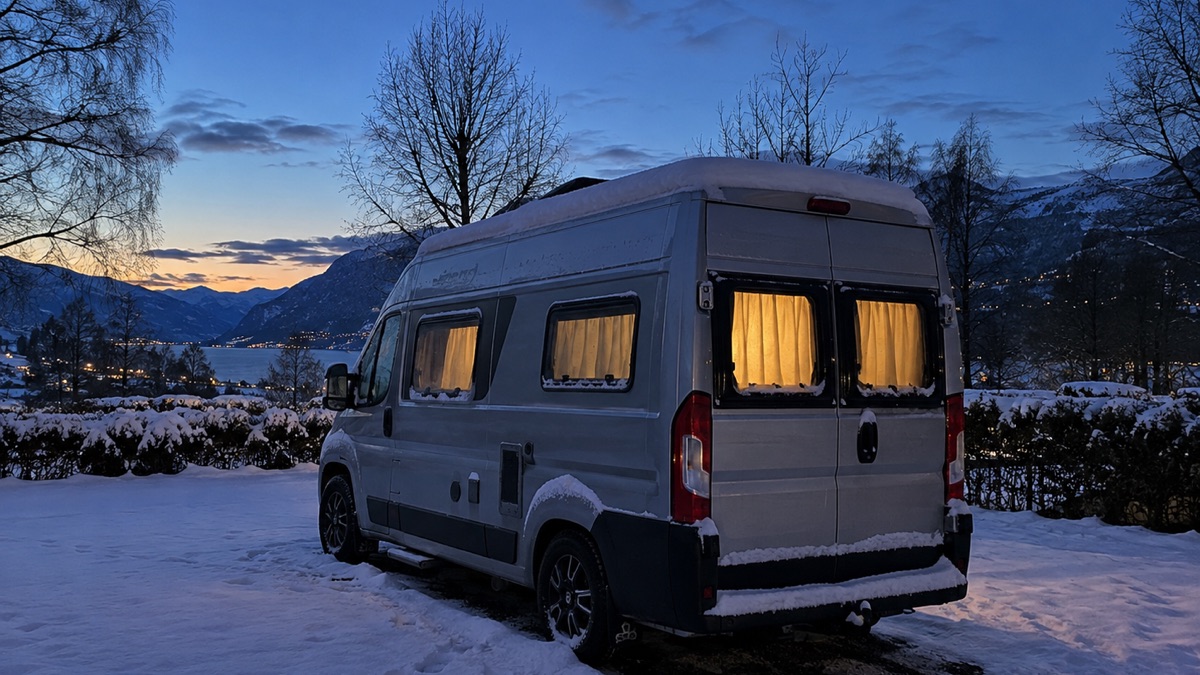
In winter, it's not just you who gets cold. Water, battery and diesel have their limits too, and they like to speak up at three in the morning.
Sleeping warm
- Choose the sleeping bag by its comfort temperature, not the extreme value. Both are on the bag under EN ISO 23537-1, and the extreme value is the survival limit.
- Choose the sleeping mat by R-value (measured to ASTM F3340). If two mats lie on top of each other, their R-values add up.
- In a roof tent you freeze from below more than from above. The mattress is thin and there is outside air under it. An extra mat or blanket underneath helps more than a thicker sleeping bag.
- In a van, the mattress often lies on cold sheet metal. An insulating layer underneath helps.
Water
- Many boilers, for example from Truma, have a frost guard. It opens by itself at about 3 °C and drains the hot water. That's its job. So the splashing under the van isn't a leak.
- It never closes by itself. That only works by hand: press the push button until it clicks into place. That only works once it is warmer than about 7 °C at the valve. So heat first, then close the valve, then fill up with water. Other heaters do this differently. If in doubt, check the manual.
- Without heating overnight, empty the fresh water tank and the pipes and leave the taps open. The tank in a van is the first candidate for frost damage.
- In a roof tent with a jerrycan: keep the water in the car or the tent at night, not outside. Don't fill the jerrycan to the brim. Ice needs more room and will otherwise burst it.
Power
Lithium batteries (LiFePO4) must not be charged below 0 °C. Charging in frost can damage them permanently, while discharging works much lower, down to about minus 20 °C. Many batteries block charging by themselves or have a heater. Whether and how far is in your battery's data sheet, and that takes precedence. If you use a booster, solar or shore power, know this before you start in the morning at minus 6 degrees.
Vehicle
- In Germany, for example, winter diesel is sold from 16 November to the end of February, flowing down to about minus 20 °C. Before that, from 1 October, transitional diesel is on sale, good only down to about minus 10 °C.
- If you fill up in the south in autumn and then drive into the Alps, you may have diesel in the tank that is too mild for it. Other countries have their own dates and cold limits.
- Put antifreeze in the washer fluid, or the system freezes up.
- Tyres and chains have their own rules in each country. In the Rauholm app, you'll find them on the country page.
Heating
- Only heat with a permanently installed heater whose exhaust goes outside. Clear the outlet after snowfall.
- Hang up a carbon monoxide alarm for vehicles (EN 50291-2).
- Never heat with a stove or gas grill, not even briefly.
- Gas in the cold: propane instead of butane, a winter blend for cartridges. More in “Camping stoves and carbon monoxide”.
Sources
- EN ISO 23537-1: Requirements for sleeping bags
- ASTM F3340: R-value of sleeping pads
- Truma Support: FrostControl heating element
- promobil: Warum Lithium-Akkus eine Heizung brauchen
- RELiON: How do LiFePO4 batteries perform in cold temperatures
- promobil: Ab wann gibt es Winterdiesel
- auto motor und sport: Ab wann gibt es Winterdiesel
- Our own experience, Yannic and Marc